NeurIPS 2026Track on Evaluations and Datasets

CineMME From Dialogue Grounding to Narrative Reasoning in Multimodal Video Understanding

Jin Liu1,2,4 Dawei Du4 Yexiang Liu2,3,4 Sijie Zhu4 Fan Chen4 Junxian Duan2,3 Huaibo Huang2,3 Ran He1,2,3 Longyin Wen4 Zhenfang Chen4,*
1School of Information Science and Technology, ShanghaiTech University 2MAIS & NLPR, Institute of Automation, Chinese Academy of Sciences 3School of Artificial Intelligence, University of Chinese Academy of Sciences 4ByteDance Intelligent Creation *Corresponding author
Grounding · tIoU ↑Whenis the line spoken?
Grounding · WER ↓Whatis said?
Grounding · vIoU ↑Whosays it?
Reasoning · MCQ · OEQWhydoes it matter for the plot?
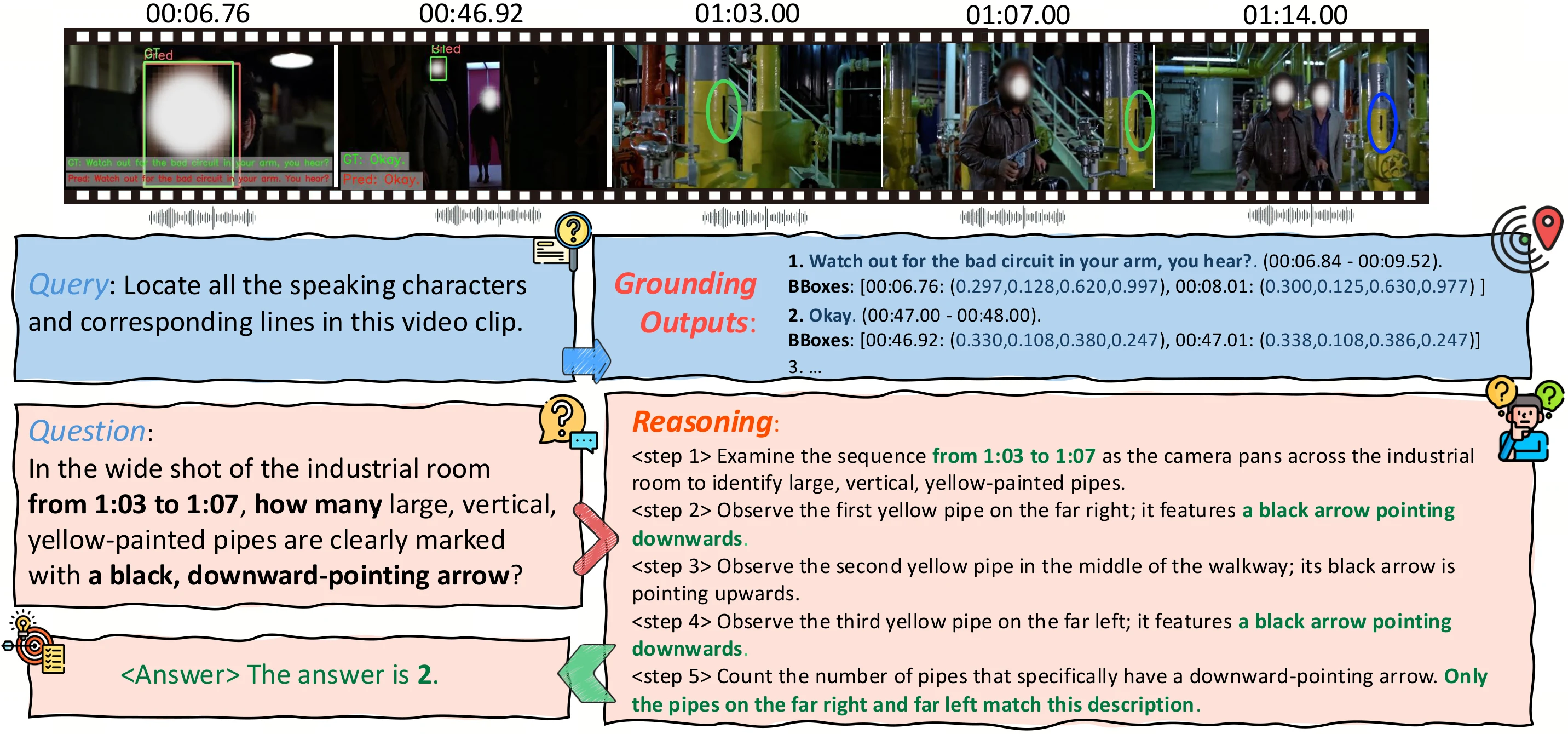
CineMME example. Top: a grounding query asks the model to locate every spoken line with its timestamps and the speaker's face boxes. Bottom: a reasoning question about the same clip, with a step-by-step answer that cites time ranges.
Two linked tracks on the same clips. CineMME-Grounding (top) asks when a line is spoken, what is said, and which face says it. CineMME-Reasoning (bottom) asks questions that require using this temporally grounded evidence. Faces are blurred in all figures. Click the figure for full size.

Abstract

Narrative video understanding requires more than recognizing visible events: models must extract evidence from dialogue, bind it to speakers, and use it to infer narrative meaning. Existing video benchmarks evaluate aspects of this problem, including video question answering, audio-visual reasoning, and temporal grounding, but rarely test whether these abilities form a coherent dialogue-to-plot evidence chain within the same clips.

We introduce CineMME, a human-verified benchmark designed to diagnose dialogue-grounded plot understanding, supported by approximately 1,600 expert person-hours of annotation. CineMME contains 975 curated short narrative video clips and two linked tracks: CineMME-Grounding, with 13,554 timestamped speech segments and 33,083 speaker face boxes for temporal dialogue localization, transcription, and active-speaker grounding; and CineMME-Reasoning, with 1,600 multiple-choice and 316 open-ended questions spanning perception, audio, narrative, social, and scene-presentation understanding.

Our main evaluation compares 20 MLLMs on reasoning and 9 omni-modal models on grounding. The results reveal a pronounced who-what-when decoupling: Gemini-3 Pro localizes dialogue in time (68.34% tIoU) and transcribes it with a WER of 28.99%, yet achieves only 7.74% vIoU for active-speaker grounding while achieving 67.66% MCQ accuracy on questions with extractable answers. Modality ablations further show that vision is not uniformly beneficial: it improves performance on perception-heavy questions but can hurt dialogue-centric reasoning. CineMME provides a compact diagnostic testbed for evaluating how multimodal video models connect dialogue, speakers, visual evidence, and narrative meaning.
Results from the paper · updated November 2026

Leaderboard

Weights
Input

To add a model, run the evaluation scripts in the code repository and open an issue with your predictions and the scores they produce.

Findings

Models partly find when a line is spoken, but rarely who says it

Gemini-3 Pro localizes dialogue in time and transcribes much of it, yet localizes the speaking face in only 7.74% vIoU, the best score of any model. In the main table, the best open-weight model (Qwen3-Omni) reaches 3.18% vIoU.

Adding video helps perception but can hurt dialogue-centric reasoning

Change in Gemini-3 Pro MCQ accuracy (points) when video frames are added to the audio track. Perception rises from 67.54% to 79.39%; Audio drops from 74.43% to 68.21%.

The best proprietary model leads the best open model by 29 points

MCQ accuracy. Qwen3-Omni is the best open-weight model. Six graduate volunteers scored 77.64% on a 161-question subset (95% CI 70.60–83.39%).

More frames do not fix speaker grounding

Qwen3-Omni inputtIoU ↑vIoU ↑WER ↓
A+V, 16 frames54.663.8272.20
A+V, 64 frames50.483.6775.92
A+V, 256 frames50.403.0171.52
A+V, 1 FPS (main table)49.253.1875.79
Audio only63.581.9236.77

Going from 16 to 256 frames per video keeps MCQ accuracy between 37.31% and 39.40% and vIoU between 3.01% and 3.82%. Audio-only input gives the best timing and transcription.

Benchmark

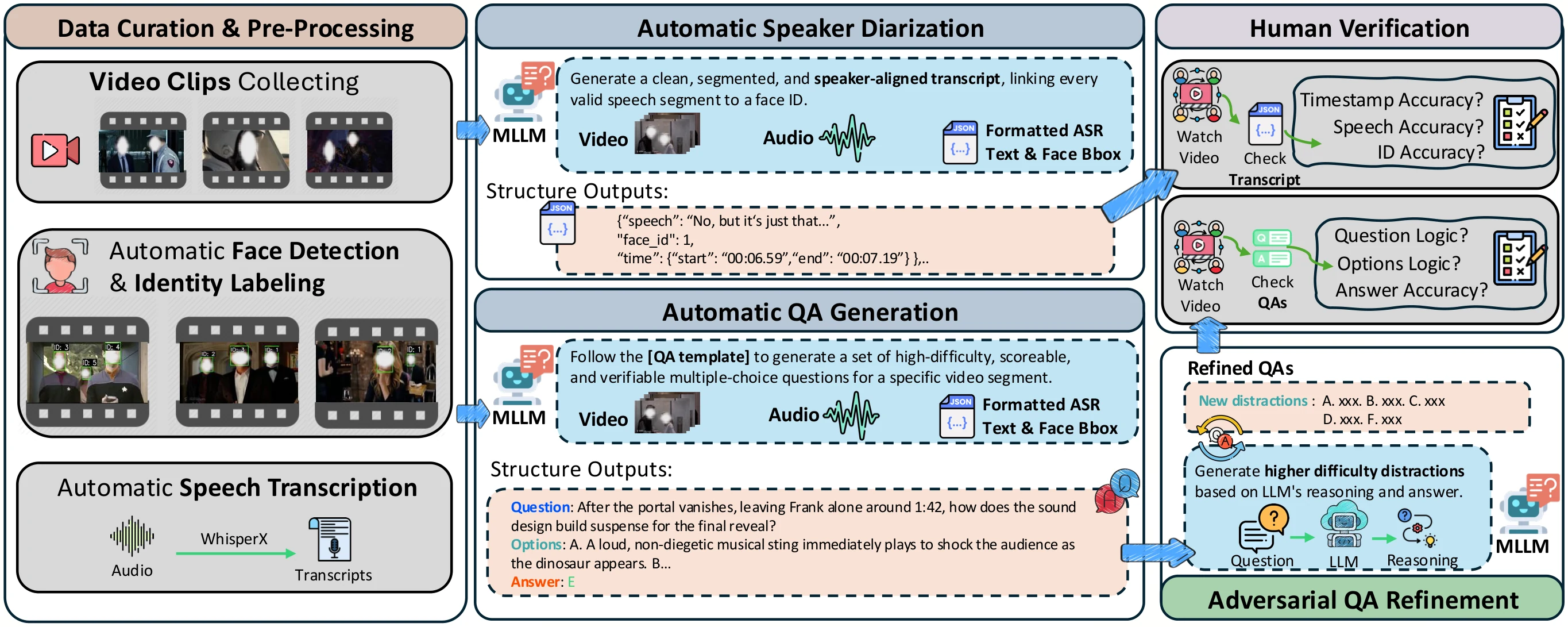
Annotation pipeline: clip collection, face detection and identity labeling, and WhisperX transcription feed an MLLM that drafts speaker-aligned transcripts and multiple-choice questions; an adversarial step rewrites distractors; annotators then check timestamps, speech, speaker IDs, question logic, options, and answers.
Annotation pipeline. WhisperX and InsightFace propose speech segments and face tracks. MLLMs draft speaker attribution, questions, and answer options, and an adversarial pass rewrites distractors that a model can shortcut. Expert annotators decide every final label in a double-blind check.

Dataset statistics

Short speech segments demand precise timing, and 86.0% of speaker face boxes cover less than 15% of the frame, which makes speaker grounding hard in multi-person scenes. Questions are spread across five categories, and 76.1% of them exceed 20 words.

How CineMME compares

BenchmarkVideosQ&AAnno.ModalityMCQOpen-endedSpatial groundingTemporal groundingSpeech
Visual benchmarks
Video-MME9002.7KMV✓✗✗✗✗
MLVU1,7303.1KA+MV✓✓✗✗✗
Omni benchmarks
LongVALE8.4K–AV+A✗✗✗✓✓
AV-Odyssey–4.6KA+MI+A✓✗✗✗✗
Plot benchmarks
CinePile9,396304KA+MV✓✗✗✗✗
Movie101/v2––MV✗✓✗✗✗
Grounding benchmarks
TimeLens-Bench4,2796.5KMV✗✗✗✓✗
SVAG-Bench68819.6KA+MV✗✗✓✓✗
CineMME (ours)9751.9KA+MV+A✓✓✓✓✓

Anno.: A automatic, M manual. Modality: V video, A audio, I image. ✓ supported, ✗ not supported, – not reported.

Citation

@inproceedings{liu2026cinemme,
  title     = {{CineMME}: From Dialogue Grounding to Narrative Reasoning in Multimodal Video Understanding},
  author    = {Liu, Jin and Du, Dawei and Liu, Yexiang and Zhu, Sijie and Chen, Fan and Duan, Junxian and Huang, Huaibo and He, Ran and Wen, Longyin and Chen, Zhenfang},
  booktitle = {Advances in Neural Information Processing Systems (NeurIPS), Track on Evaluations and Datasets},
  year      = {2026},
  note      = {arXiv:2611.15161}
}